
Best 4K Dash Cam 2026: Top Picks Ranked by Use Case

A 4k dash cam only earns its price if the footage is still watchable at 2 a.m. and the card hasn't overwritten the one clip you needed. This guide ranks the best 4k dash cam types for 2026 by what they actually solve on the road, not just megapixel counts.
TL;DR
Dual-channel 4k dash cam wins overall for drivers who need front and rear coverage in one clip.
Mirror-style 4k dash cams, like AutoTitan's MC750-style unit, hide in plain sight on the windshield.
Parking-mode 4k dash cams with a hardwire kit catch hit-and-run damage while the car sits.
Single-channel 4k dash cams stay the cheapest entry point but skip rear-facing evidence entirely.
GPS-enabled 4k dash cams log speed and location for insurance claims, not just video.
Why this matters
A 4k sensor helps you read a license plate that a 1080p camera turns into a smear, but resolution alone doesn't stop a dead battery from wiping your parking-mode footage or a slow microSD card from dropping frames mid-recording. AutoTitan sells dash cams alongside CarPlay upgrades because the two problems overlap: drivers replacing a factory screen in 2026 are usually the same drivers finally adding a real 4k dash cam instead of the phone-mount camera they've used for years.
The honest answer to "what's the best 4k dash cam" depends on whether you're protecting against a hit-and-run in a parking lot, documenting a commute for insurance, or just want sharper footage than your old 1080p unit. This guide ranks by that use case instead of pretending one camera wins every category.
What makes the best 4K dash cam
Sensor resolution and low-light handling. True 4k footage that turns to mush after dark doesn't help you read a plate at night.
Parking mode power source. A hardwire kit with a low-voltage cutoff or a capacitor protects the car battery better than a lithium battery baking on a hot dash.
Loop recording and card speed. 4k bitrates need a card rated for continuous video (V30 or higher) or the camera drops frames instead of erroring out.
GPS and speed logging. Timestamped location and speed data backs up an insurance claim without relying on memory.
App or Wi-Fi transfer. Pulling a clip in seconds beats pulling the card and finding a laptop.
Mounting form factor. A compact cube, a mirror-style housing, and a windshield puck all change how visible the camera is and how it fits your dash.
Best 4K dash cams for 2026 at a glance
Type | Best for | Standout feature | Key limitation |
Dual-channel 4K dash cam | Full front-and-rear coverage | One clip covers both directions | Two cables to route through the headliner |
Mirror-style 4K dash cam | Discreet OEM-look mounting | Replaces the factory mirror | Bulkier housing than a stock mirror |
Parking-mode 4K + hardwire kit | Parking lot security | Motion-triggered recording while parked | Wiring to the fuse box isn't a plug-and-play job |
Single-channel 4K dash cam | Budget-conscious drivers | Simplest single-cable install | No rear or side coverage |
GPS-enabled 4K dash cam | Insurance and speed documentation | Location and speed overlay on playback | Extra antenna cable to route |
Wi-Fi app-connected 4K dash cam | Quick clip sharing | Send footage to your phone in minutes | Wi-Fi transfer is slower than pulling the card |
1. Dual-channel 4K dash cam: best 4k dash cam for full front-and-rear coverage
A dual-channel setup records the road ahead at true 4k while a second lens covers the rear window or the cabin, so one incident produces one file that shows both directions.
Dual-channel 4K dash cam pros:
Full coverage for rear-end collisions and lane-change disputes
Front lens usually holds 4k even when the rear channel drops to 1080p
Single app manages both feeds and syncs playback
Dual-channel 4K dash cam cons:
Two cables to route through the headliner and rear pillar
A rear lens mounted on glass can catch reflections at night
Needs a larger, faster microSD card to hold both streams
Best for: drivers who want proof of what happened in front of and behind the car in the same clip. Verdict: Buy.
2. Mirror-style 4K dash cam: best for discreet OEM-look mounting
A mirror-style unit, like AutoTitan's MC750-style camera, clips over or replaces the factory rearview mirror so the housing looks like a normal mirror instead of a black cube stuck to the windshield.
Mirror-style 4K dash cam pros:
Keeps the windshield clear of extra hardware
Doubles as a functional rearview mirror during the day
Usually pairs a front lens with a rear-facing or cabin lens
Mirror-style 4K dash cam cons:
The housing is bulkier than a stock mirror
Touchscreen controls on the mirror face take a few drives to learn
Harder to remove and swap into a second car
Best for: drivers who don't want a visible dash cam on the glass. Verdict: Buy.
A mirror-style unit keeps the windshield free of a visible camera cube.
3. Parking-mode 4K dash cam with hardwire kit: best for parking security
This setup stays partially powered while the car is off, recording motion or impact events in a driveway or parking lot.
Parking-mode 4K dash cam pros:
Catches hit-and-run damage and break-in attempts
A hardwire kit with a low-voltage cutoff protects the car battery
Motion-triggered clips keep card space free for driving footage
Parking-mode 4K dash cam cons:
Installing the hardwire kit means running a wire to the fuse box
Capacitor-based units cost more upfront than battery-based ones
Battery-based parking mode drains faster in cold weather
Best for: street parkers and anyone who's had a car keyed or bumped in a lot. Verdict: Buy.
4. Single-channel 4K dash cam: best for budget-conscious drivers
One forward-facing lens records the road at 4k with no rear or cabin camera involved.
Single-channel 4K dash cam pros:
Simplest install, usually a suction-cup or adhesive mount with one power cable
Smaller footprint on the windshield
Easier to move between vehicles
Single-channel 4K dash cam cons:
No record of what happened behind or beside the car
Most skip parking mode or offer a stripped-down version
You lose evidence if the collision comes from the side or rear
Best for: a first dash cam or a second car that doesn't need full coverage. Verdict: Buy for the price-first shopper, Skip if you drive in heavy city traffic where side and rear-end collisions are common.
5. GPS-enabled 4K dash cam: best for insurance and speed documentation
This type logs location, route, and speed alongside the video, then overlays that data during playback.
GPS-enabled 4K dash cam pros:
Speed and location data backs up an insurance claim without relying on memory
Route logging helps drivers who log mileage for work
Some models plot the entire drive on a map afterward
GPS-enabled 4K dash cam cons:
The GPS antenna adds another cable to route
Location logging means the footage carries more personal data if shared
Satellite lock can take a minute or two after a cold start
Best for: rideshare and delivery drivers who need speed proof, or anyone who wants location-stamped footage for a claim. Verdict: Buy.
6. Wi-Fi app-connected 4K dash cam: best for quick clip sharing
This type pushes footage to a phone app over Wi-Fi so you don't have to pull the microSD card to grab a clip.
Wi-Fi app-connected 4K dash cam pros:
Fastest way to save and share a clip right after an incident
Live preview on the app helps confirm mount angle during install
Pairs naturally with a phone already running your CarPlay setup
Wi-Fi app-connected 4K dash cam cons:
Wi-Fi transfer is slower than pulling the card directly for long clips
App quality varies more than the camera hardware does
Needs a phone in range to trigger a transfer
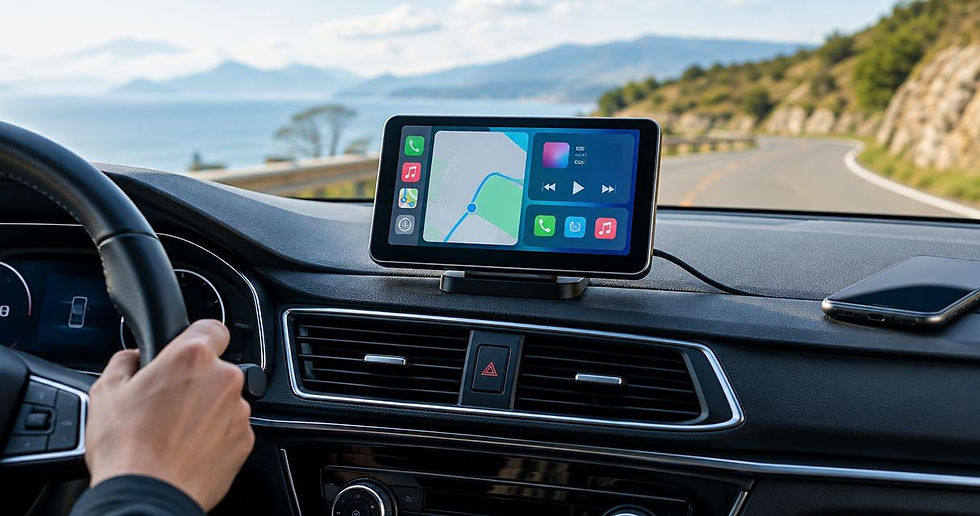
Best for: drivers who want to send a clip to insurance or a passenger in minutes. Verdict: Buy. Pairing a Wi-Fi dash cam with a dedicated screen turns the feed and navigation into one display instead of two mounted devices — the AI CarPlay box picks cover how that pairing works.
Find your 4K dash cam
Compare dual-channel, mirror-style, and parking-mode options in one place.
How we ranked these
Each type is judged against the same six criteria from the section above: sensor and low-light quality, parking mode power source, loop recording reliability, GPS logging, app connectivity, and mounting form factor. No single 4k dash cam wins on all six, which is why this list ranks by use case instead of naming one universal winner.
Which 4K dash cam should you choose?
Most drivers should start with a dual-channel 4k dash cam — it covers the two most common insurance disputes (rear-end and lane-change) in a single clip. If a visible camera cube bothers you, the mirror-style 4k dash cam solves that without giving up front-and-rear coverage. Street parkers should treat the parking-mode setup with a hardwire kit as non-negotiable, since that's the only type that protects the car when nobody's in it. Budget shoppers and second-car owners can stop at the single-channel 4k dash cam and upgrade later.
FAQ
What's the best 4k dash cam for most drivers in 2026?
A dual-channel 4k dash cam is the best overall pick for 2026 because it records front and rear footage in one file, covering the two most common collision disputes. Single-channel units cost less but leave rear and side impacts undocumented.
Is a 4k dash cam better than a 1080p dash cam?
Yes, for reading license plates and road signs, since 4k resolution holds detail that 1080p loses at distance or at night. The tradeoff is a larger file size, so a 4k dash cam needs a faster microSD card to avoid dropped frames.
Do I need parking mode on a 4K dash cam?
Parking mode matters most if you park on the street or in shared lots, since it records motion or impact while the car is off. A hardwire kit with a low-voltage cutoff protects the car battery better than relying on the camera's internal battery.
How much microSD card space does a 4K dash cam need?
4k dash cams need a card rated V30 or higher to keep up with the bitrate without dropping frames. Loop recording overwrites the oldest footage automatically once the card fills, so card speed matters more than raw capacity alone.
Can a mirror-style 4K dash cam replace my factory rearview mirror?
Yes, most mirror-style 4k dash cams clip over or replace the factory mirror mount and function as a normal mirror during the day. The housing is bulkier than a stock mirror, which is the main tradeoff for the discreet look.
Does a 4K dash cam work with a CarPlay upgrade?
A Wi-Fi-connected 4k dash cam can share the same phone pairing as an AI CarPlay box, letting navigation and dash cam footage run through one setup instead of two separate mounted devices.
What's the difference between GPS dash cams and standard 4K dash cams?
A GPS-enabled 4k dash cam logs location and speed alongside the video and overlays that data on playback, which strengthens insurance claims. A standard 4k dash cam without GPS only provides the video itself.
One last thing
The camera sensor rarely fails first on a 4k dash cam — the microSD card does, because continuous loop recording writes and erases the same cells thousands of times a year. A card rated for continuous video (endurance-rated, not a standard consumer card) outlasts a generic high-capacity card even when both list the same storage size.


Comments